
Today's practices are rethinking how they manage insurance
Dental insurance helps many patients access care, but it’s not always built to support the needs of modern practices. Reimbursements haven’t kept pace with rising costs, and administrative demands continue to grow. That puts pressure on teams who are already working hard to deliver great care.
Most practices still participate in insurance to support their patients. But more are asking: how do we strike the right balance?
Low fee schedules, claim denials, and annual maximums can limit production and predictability. At the same time, labor, supplies, and technology costs continue to climb. It’s getting harder to protect margins and plan for growth.
That’s why practices are taking a closer look at their payer mix. By optimizing participation and building in alternatives for uninsured patients, they’re creating a model that protects access to care while strengthening the business behind it.
You don’t have to overhaul everything at once. But you can take a strategic step toward a more balanced, sustainable approach.
When care is in your control growth happens
When your team has more control over how care is delivered, everything works better. Patients feel more confident saying yes to treatment. Teams spend less time on administrative tasks. And your practice becomes more productive, more efficient, and better positioned for growth.
At Clerri, we help dental teams remove the barriers that stand between patients and the care they need.
A key part of that process is optimizing your payer strategy. That may include reducing dependence on PPOs that no longer support your goals. It’s a strategic shift, and it’s one that requires careful planning to protect patient trust and practice performance.
This playbook outlines a proven framework to help you take control with confidence. Each step is designed to support your team, your patients, and your long-term success.
- Face your fears
- Implement a dental membership plan
- Analyze your PPOs
- Renegotiate or drop PPOs
- Support your patients through the transition
- Market to new patients
This guide is based on insights from practices who’ve made this transition and seen stronger production, better retention, and more predictable revenue.
1. Face your fears
Many dental teams feel stuck. They know certain PPOs are no longer serving their practice, but worry about what might happen if they make a change. What if patients leave? What if production drops? What if the risks outweigh the reward?
These concerns are common and completely valid. Often, the fear of disruption is what keeps things exactly the same.
Maybe most practices in your area accept the plan. Maybe a major employer nearby offers it. Or maybe some of your most loyal patients are covered by it. That makes the idea of stepping back feel even harder.
But without understanding how each plan impacts your practice, it’s impossible to move forward with clarity or confidence.
The margin of error when dropping a PPO is much larger than you may realize. Insurance-based practices collect just 60% of their UCR once insurance discounts and claim denials are factored in. Fee-for-service practices collect 100%. This provides a 40% margin of error when you drop a PPO.
For example, even if you stepped back from a PPO and 40 percent of those patients chose not to stay, your collections could still hold steady. You would work fewer hours, manage fewer administrative tasks, and have more time.
- You have more control than you think. Facing your fears is the first step toward building a model that supports both your patients and your growth.
2. Implement a dental membership plan
Before dropping and renegotiating PPOs, it’s important to implement a dental membership plan. A membership plan provides a great option for patients to switch to if you no longer accept their insurance. It also fills a coverage gap for your existing cash-pay patients. Moreover, a membership plan will increase production and generate recurring revenue that will help fill gaps created by patients that leave your practice.
You’re in control of the plan. You decide the pricing, benefits, and structure. Payments go directly to your practice, and patients get the kind of experience they’ve been waiting for — simple and transparent.
Your cash-pay patients want a membership plan
Care is catching up to the subscription economy. Nearly half of Americans (48%) say they’re interested in subscription-based care — and that interest rises even more among patients without dental insurance.
Your dental membership plan will give patients exactly what they want. Payments are affordable, prices are transparent, coverage is easy to understand, and there are no hassles like deductibles, pre-approvals and annual maximums. Plus, patient benefits start the minute they join.
Membership plans improve your practice's results
By making it easier for patients to commit to the care they need, providers create a “membership effect” that results in increased patient loyalty and visits, treatment acceptance and production.
In fact, according to data from Clerri customers, membership plan patients make 2-3X more hygiene re-appointments and generate 2X the production of cash-pay patients.
Additionally, subscription-based membership plans generate consistent, recurring revenue that your practice can depend on.
Set your plan up for success with these best practices
- Provide comprehensive treatment. Include preventive care — usually two cleanings, two exams, and routine X-rays each year — and discounts on additional treatment.
- Provide transparent pricing and price it right. Transparent pricing builds patient trust. Price your plans to achieve the optimal balance of patient value and practice results.
- Ensure compliance. Dental plans must adhere to multiple federal and state regulations, including HIPAA, DMPO licensure, consumer protection law, and payment processing laws.
- Make it simple to join. It should be easy for patients to sign up from any device.
- Make it easy to pay. Consider whether you will offer monthly or yearly payment plans or both. More now than ever, patients will appreciate the option to pay monthly installments.
- Make it immediate. Begin benefits the moment a patient signs up.
- Make it hassle free. Eliminate sign-up fees, deductibles, waiting periods, annual maximums, and pre-approvals.
- Assign a plan champion. Assign one person in your office to manage and track the plan.
- Get your team on board. Make sure all members of your team, including the doctors, understand and promote the benefits of a membership plan to your patients.
- Offer your plan to everyone! Don’t pick and choose to whom you offer your membership plan.
- Set goals and track progress. You can start small and then build. Initially, set a goal to sign up 25% of the cash-pay patients you see each week.
- Promote the plan. Promote it in your office, on your website, and through email and social media.
- Want to take this off your plate? Clerri gives you the platform, automation, and support to make membership effortless.
3. Analyze your PPOs
Now it’s time to analyze your PPOs so you can understand the value each PPO brings to your practice and the impact dropping them will have on your results. This step requires an inventory of your insurance participation and some math.
Start by reviewing your insurance agreements and practice management data. You will need to document the following for each plan you participate in:
- Participating doctors
- Fee schedule (make sure it is current!)
- Number of patients that used the plan in the last calendar year (“Plan Patients”)
Total net production for the last calendar year
- Net production per patient (“Net Production” divided by “Plan Patients”)
- Treatment frequency by procedure code for the last calendar year
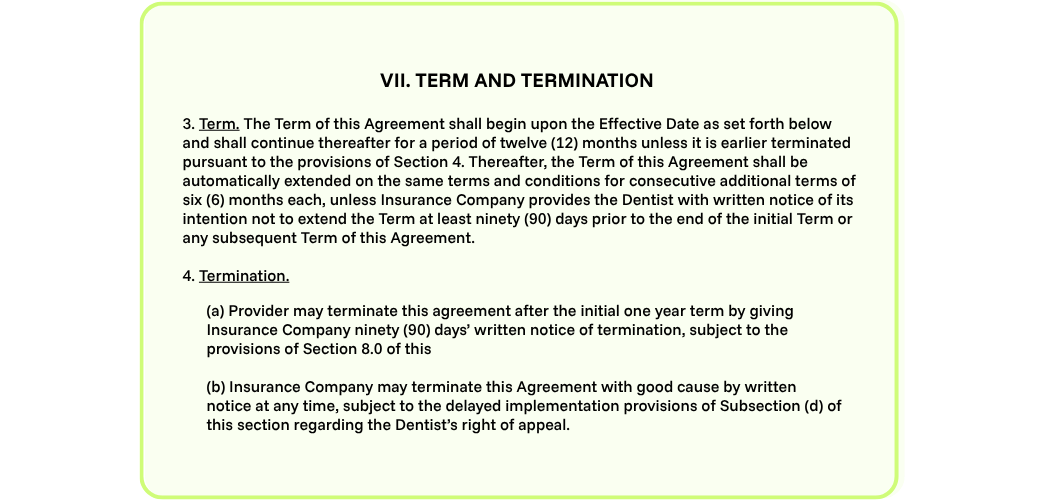
- Termination notice (termination typically requires a 90 day notice that must be in writing). Here is an example of how the termination details will be listed in your agreement.
Take a closer look at the numbers
This step is all about clarity. Before making any changes to your PPO participation, you’ll want to understand exactly how each plan is impacting your practice.
Start by calculating the weighted average discount for each PPO. Then, look at the number of patients and the net production tied to each plan. This will help you see which PPOs to keep, which to renegotiate, and which may no longer align with your goals.
We know this can feel overwhelming, and that’s okay. Most practices need support here — and that’s why we’re ready to help.
As a Clerri customer, we can connect you with a trusted consultant who will help you run the numbers and build a strategy that fits your practice.
Once you have a clear picture of your current payer mix, you’re ready for the next step: renegotiate or reduce your PPO participation with confidence.
4. Renegotiate or drop PPOs
Now it’s time to renegotiate the PPO plans that can work for your practice and set exit dates for the ones that don’t. Here are a few ways to build a strong case:
- Focus on high-impact codes
Identify 10 to 15 of your most valuable procedure codes — either the ones you use most or those with the highest cost — and make those the basis of your proposal. - Build a fair and competitive fee schedule
Propose reimbursement rates that reflect both your production and the realities of the market. - Highlight what makes your practice stand out
Do you have a strong patient retention rate? Do you serve a large number of patients from that payer? Show them where your practice delivers value. - Know your leverage
Only mention termination if you’re prepared to follow through. In some cases, simply being ready to walk away gives you the confidence to negotiate better terms.
Once you have answered these questions and have created a proposal, send it to the PPO administrator to start negotiations. For the plans you want to drop, set an exit date and appropriately notify the insurance companies of your intentions to cancel within the specified time frame in the terms and conditions of your agreement.
Do not rush this process. Gain confidence by negotiating and dropping one PPO at a time starting with plans with the fewest participating patients and/or the lowest reimbursement. You will learn during these first attempts, while also giving your team the confidence to move forward in tackling the plans with more patients and larger financial implications.
5. Support patients through the transition
Communicating with your patients and providing high levels of customer service will be critical as you transition away from a PPO. To retain patients who are covered by an insurance plan that your practice is dropping, be sure to take the following steps.
- Identify patients impacted
- Communicate the change to impacted patients
- Assist patients with insurance reimbursements
Identify patients impacted
Run a report from your practice management system to identify patients who are covered by each insurance plan you are dropping. The report should include patient name, insurance plan, last visit, next visit, email and phone number.
Communicate with care
When making changes to your PPO participation, how you share the news with patients matters just as much as the change itself. Clear, proactive communication builds trust and helps patients feel supported through the transition.
If possible, avoid impersonal letters. A personal phone call or in-person conversation during a visit is far more effective. It allows your team to answer questions, offer reassurance, and introduce your membership plan as an alternative — so patients know they still have a way to access, ongoing care with your practice.
If you’re notifying patients in advance, a thoughtful communication plan can help:
- Start six months before your exit date
- Send reminder emails around 90 days and again at 30 days
- Follow up with calls or in-person conversations when possible
When sharing the message:
- Lead with your “why”
Share that this change is about delivering better care without unnecessary restrictions. You’re focused on more time with patients, fewer administrative delays, and less interference in care decisions. - Reassure them that they can still see you
Even if you’re no longer in-network, as an unrestricted provider your practice can still treat patients with any insurance plan. Let them know nothing changes in how you care for them. - Explain how payments will work
Let patients know that payment will now be due in full at the time of their visit. You can accept cash, check, credit card, or HSA. - Offer support with claims
Inform patients that you’ll help them submit claims for reimbursement (if you're able). A quick explanation of how you’ll support that process can ease their concerns. - Share financing options
For patients facing larger treatment costs, remind them that flexible payment options like sunbit are available. - Introduce your membership plan
This is the perfect time to offer an alternative path to care.
Assist patients with reimbursements
Your practice should develop a process for helping patients with reimbursements. Most practices that have successfully moved out-of-network with PPOs continue to submit claim paperwork on behalf of their patients.
This process will be the same as you currently use in-network, but will be submitted on behalf of your patient, not your practice.
As you reduce PPO participation, you will lose some patients. Backfilling these patients will require a new patient marketing plan.
6. Market to new patients
As you transition PPOs out of your practice, you will lose some patients who were more committed to their insurance plans than your practice.
You need to determine how many of these patients you want to replace and develop a marketing plan to attract them to your practice. Here are some simple tips for marketing to prospective patients:
- Create a marketing voice that will differentiate your practice
- Determine how many new patients you want to attract
- Create your budget
- Target your audience
- Develop your message and campaigns
- Deliver a truly superior patient experience
Most teams don’t have time to build a marketing plan from scratch. That’s why Clerri comes with the essentials already built in. Our membership platform is equipped with automated campaigns to identify and market to existing patients in your database, ready-to-use print and digital assets to promote your plan externally, and clear insight into how enrollment is trending.
If you want extra support, we’ll connect you with experts who can help build a robust marketing strategy.
Make the transition work for your practice
As you change how your practice participates with PPOs, keeping patients connected to your care is critical.
Clerri helps you do exactly that. Our dental membership platform gives patients a simple alternative to stay with your practice. It also helps you re-engage your current cash-pay patients.
The result is a smoother transition for your team and a stronger foundation for your practice moving forward.